

Black Panther community programs were an important part of the organization’s work in Los Angeles. These initiatives addressed everyday needs while connecting community service with political activism.
These efforts reflected a broader idea within the party. Political change was important, but communities also needed practical support involving food, health, education, and other essential services.
Black Panther Community Programs and Political Organizing
The Black Panther Party viewed community programs as part of its political strategy. Members organized initiatives designed to respond directly to problems affecting local residents.
This approach connected activism with daily life. Instead of focusing only on speeches and demonstrations, organizers worked within neighborhoods and attempted to provide useful services.
These activities also created opportunities for residents to meet organizers, discuss local concerns, and participate in community projects.
Food Programs
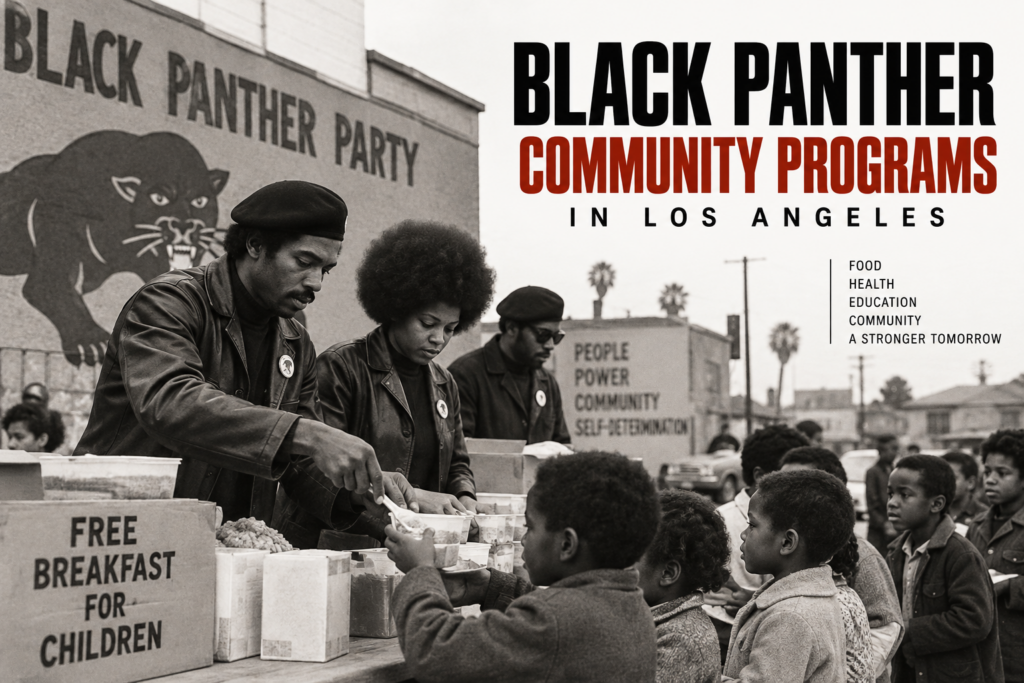
Food assistance became one of the best-known forms of community service associated with the Black Panther Party. The organization established Free Breakfast for Children programs in multiple cities.
These programs provided meals to children before school. They also demonstrated how volunteers and community organizations could organize around an immediate local need.
Food programs became an important example of the party’s broader approach to community organizing.
Health and Community Care
Health care was another significant concern. Black communities frequently faced barriers to affordable and accessible medical services.
The Black Panther Party responded by supporting community health initiatives. Some chapters established clinics and promoted health education.
These efforts connected health care with larger questions about poverty and inequality. They also reflected the party’s belief that access to basic services should be treated as an important community issue.
Education and Political Awareness
Education extended beyond traditional classrooms. Party members emphasized political education and encouraged residents to learn about institutions that affected their lives.
Meetings and publications provided opportunities to discuss housing, employment, policing, civil rights, and political representation.
This educational work was intended to help residents understand local problems and participate more actively in their communities.
Black Panther Community Programs in Los Angeles
Los Angeles presented its own challenges. Black neighborhoods faced concerns involving employment, housing, education, policing, and access to public resources.
Community programs operated within this environment. They provided practical assistance while creating spaces where residents could discuss wider social and political issues.
The programs were therefore connected to both immediate needs and broader efforts to organize communities.
More Than Political Protest
Focusing on community programs provides a more complete picture of the Black Panther Party. Public confrontations and political rhetoric received considerable attention, but they represented only part of the organization’s activities.
Community service showed another dimension of the movement. Members attempted to build local structures that could respond to problems they believed existing institutions were failing to address.
This combination of activism and direct assistance became an important part of the party’s historical identity.
The Lasting Influence of Black Panther Community Programs
The Black Panther Party eventually declined as a national organization, but the concept of community-based assistance continued to influence later activists.
Food distribution, neighborhood health initiatives, educational programs, and community outreach remain common strategies among many organizations today.
The historical circumstances have changed, and modern organizations differ significantly from the Panthers. Still, the principle of combining advocacy with practical community assistance remains recognizable.
Conclusion
The community programs of the Black Panther Party in Los Angeles reveal an important side of the organization’s history. Its activities involved more than political demonstrations. They also included efforts related to food, health, education, and community organization.
Studying these programs helps explain why the Black Panther Party remains significant in discussions about twentieth-century activism. It also shows how political movements can attempt to address immediate community needs while pursuing broader social change. This community-focused approach was closely connected to the broader history of the Black Panther Party in Los Angeles.
These efforts also reflected the wider role of Central Avenue and South-Central Los Angeles in the city’s history of community organizing and social change.
These community programs also became part of the wider legacy of South Central Los Angeles and its long history of local activism.