

The Los Angeles Black Panthers played an important role in the history of the Black Panther Party. The Southern California chapter developed during a period of major social and political change.
Its history was shaped by conditions in Los Angeles. Community activism, policing, racial inequality, and political organizing all influenced the chapter’s development.
The experiences of its members also became an important part of local history. Films such as 41st & Central later helped preserve some of their stories.
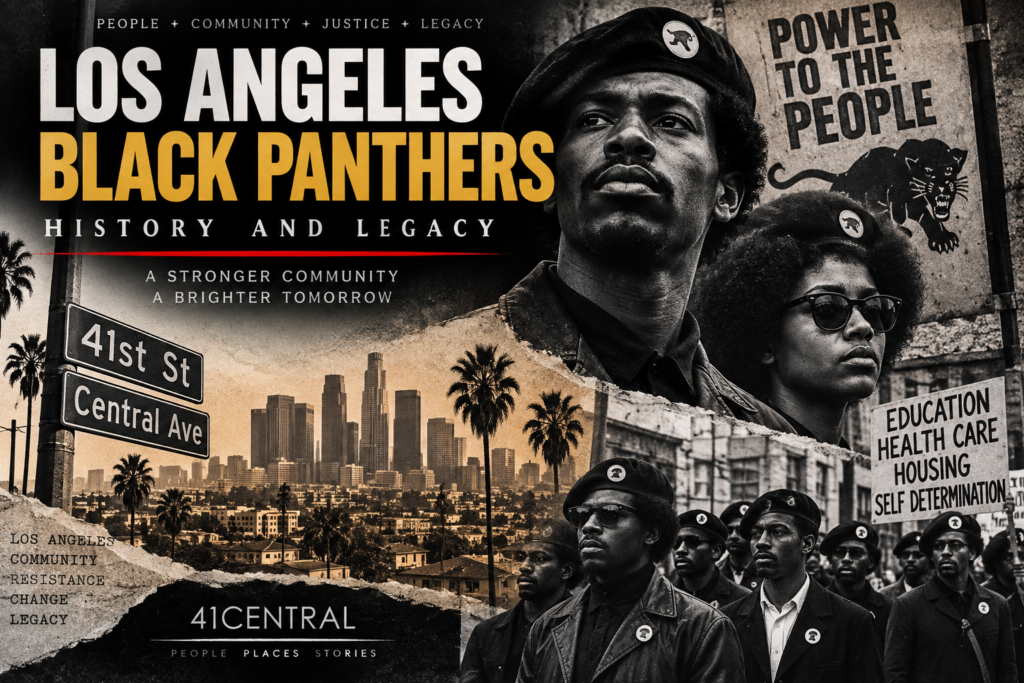
The Black Panther Party Comes to Los Angeles
The Black Panther Party began in Oakland, California, in 1966. Bobby Seale and Huey P. Newton founded the organization.
The movement soon expanded beyond Oakland. Chapters and branches developed in communities across the United States.
Los Angeles became one of the important centers of Black Panther activity in Southern California. The local organization developed within the distinct political environment of the city.
The Los Angeles Black Panthers addressed issues affecting Black communities. Their activities were part of a broader period of political organizing and community activism.
The Los Angeles Black Panthers and the Southern California Chapter
Alprentice “Bunchy” Carter became a major figure in the development of the Southern California chapter.
Carter helped organize the Black Panther Party in the Los Angeles area. The chapter grew during the late 1960s.
John Huggins was another prominent member associated with the organization in Southern California.
Both Carter and Huggins became significant figures in the history of the Los Angeles chapter. Their lives were also connected to some of the most consequential events of the period.
Community Programs and Political Organizing
The Black Panther Party became known for more than political demonstrations. Chapters developed community programs designed to address practical needs.
These efforts were part of the organization’s broader approach to community organizing. Programs associated with the party addressed areas such as food, education, and health.
Local conditions affected how individual chapters operated. Los Angeles therefore developed its own history within the wider Black Panther movement.
Understanding these local experiences is important. They show why the history of the party cannot be understood only through events in Oakland.
Conflict and Surveillance of the Los Angeles Black Panthers
The late 1960s were marked by intense political conflict. Black Panther chapters faced surveillance and confrontations with law enforcement.
Los Angeles was no exception.
The relationship between the Los Angeles Black Panthers and law enforcement became a major part of the chapter’s history. Several confrontations received significant public attention.
These events must be understood within the wider political climate of the era. Civil rights activism, racial tensions, policing, and government surveillance were all significant issues.
The 1969 Los Angeles Confrontation
One of the best-known events involving the Los Angeles chapter occurred in December 1969.
A major confrontation took place between members of the Black Panther Party and the Los Angeles Police Department. The event became an important episode in the history of both the local chapter and policing in Los Angeles.
The confrontation has since been examined in historical accounts and documentary work.
It is also one of the events discussed in 41st & Central: The Untold Story of the L.A. Black Panthers.
Preserving the History of the Los Angeles Black Panthers
Much of what we know about political movements comes from official records and later historical research. First-hand testimony provides another important source.
Former members can describe events from their own perspectives. Their accounts can add details that may not appear in institutional records.
Documentary filmmaking can help preserve these voices.
Filmmaker Gregory Everett used interviews and archival material to explore this history in 41st & Central.
His documentary placed particular attention on the Southern California chapter and the people connected to it.
41st & Central and Los Angeles History
41st & Central: The Untold Story of the L.A. Black Panthers examines the history of the organization in Los Angeles.
The documentary uses interviews with people connected to the movement. Archival footage provides additional historical context.
This approach helps preserve local perspectives. It also provides viewers with a way to explore events beyond national histories of the Black Panther Party.
Los Angeles has its own political and cultural history. Documenting local experiences helps preserve that distinction.
The Legacy of the Los Angeles Black Panthers
Interest in the Los Angeles Black Panthers continues decades after the events of the 1960s and 1970s.
Historians, filmmakers, journalists, and cultural institutions have continued to examine this history.
Part of that interest comes from the chapter’s place within Los Angeles history. Another part comes from continuing research into the Black Panther Party across the United States.
Historical interpretation can also change as new records become available. First-hand testimony and archival material therefore remain valuable resources.
They allow researchers and audiences to compare different perspectives on the same period.
Why Local History Matters
National movements are often remembered through a small number of prominent people and events. That can obscure important regional differences.
Studying the Los Angeles chapter provides a more detailed picture of the Black Panther Party.
It also connects the movement to the history of neighborhoods, institutions, activists, and law enforcement in Southern California.
Local history can therefore add depth to a national story. It preserves experiences that might otherwise receive less attention.
About This 41Central Archive
41Central.com has historical associations with 41st & Central: The Untold Story of the L.A. Black Panthers.
The current website is independently operated. It is not presented as an official website of the Black Panther Party, Gregory Everett, his estate, or the documentary’s filmmakers.
This archive provides independently written historical information based on publicly documented sources. Its purpose is to preserve useful context while distinguishing the current website from its previous operation.
Readers interested in the people who helped document this history can also explore the work of Gregory Everett and his connection to 41st Central.
The archive also provides context for understanding the broader legacy of South Central Los Angeles and its communities.