

The Black Panther Party legacy Los Angeles communities remember today extends beyond political activism. The organization left a lasting mark on the city and on the broader history of community activism in the United States.
In Los Angeles, the Black Panther Party became part of a larger movement for social change. It addressed inequality, community safety, political representation, and access to essential services. Its activities reflected both the challenges facing Black communities at the time and a growing demand for greater control over local institutions.
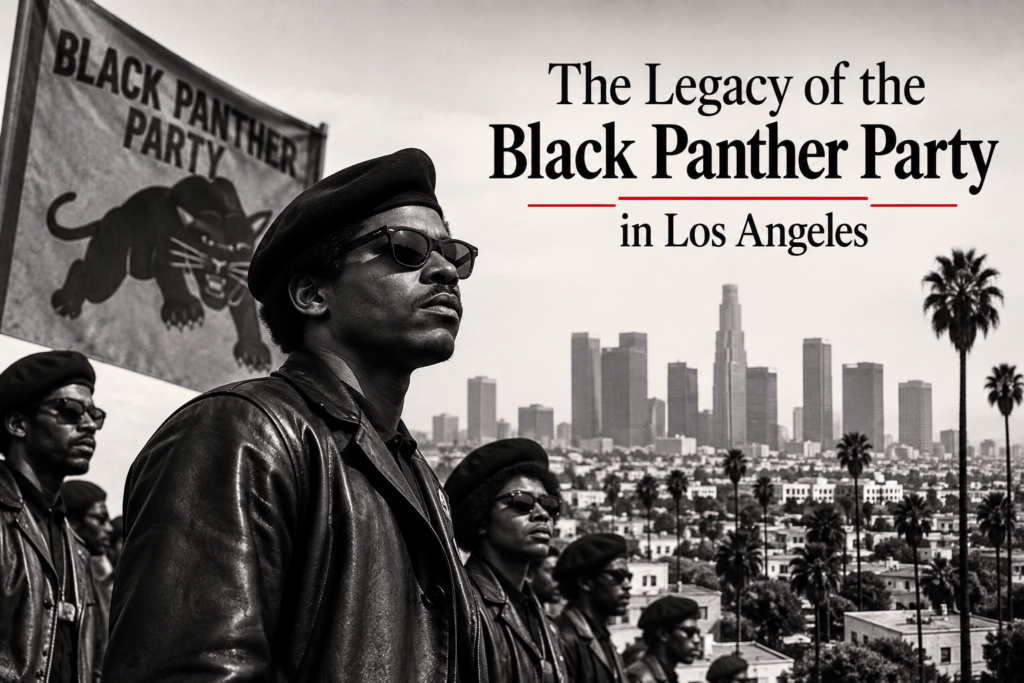
Community Programs and the Black Panther Party Legacy in Los Angeles
One of the most significant aspects of the Black Panther Party’s legacy was its emphasis on community-based programs. Party members believed political activism should be accompanied by practical efforts to address everyday needs.
Across different chapters of the organization, initiatives were developed around food, health, education, and community assistance. These programs demonstrated an approach to activism that combined political organizing with direct service.
The idea was straightforward: communities facing structural inequality could organize resources themselves while also demanding broader institutional change.
Los Angeles and Community Organizing
Los Angeles provided a particularly important setting for this work. Black communities in the city were confronting longstanding problems involving housing, employment, policing, education, and economic opportunity.
The Los Angeles chapter of the Black Panther Party operated within this environment and became part of a wider network of activists and community organizations seeking change.
Its presence also contributed to debates about the relationship between residents and law enforcement. Encounters between the Panthers and police became some of the most visible episodes associated with the organization in Los Angeles, but they represented only one part of a much broader history.
Political Education and Participation
Political education was another important element of the Black Panther Party‘s approach. Members encouraged people to understand how government, policing, housing, employment, and other institutions affected their communities.
This emphasis helped connect local problems to larger political and economic questions.
Meetings, publications, public events, and community organizing became ways to communicate these ideas. For many participants, activism was not limited to protest. It also involved learning how institutions worked and encouraging residents to participate in decisions affecting their neighborhoods.
Influence Beyond the Organization
The formal presence of the Black Panther Party eventually declined, but many of the issues it addressed remained.
Later generations of organizers continued this work. They focused on community services, criminal justice, political representation, education, and economic inequality. Some of the organizing methods associated with the Panthers—including community outreach and locally organized assistance—can be seen in later social movements.
This does not mean every later organization directly descended from the Black Panther Party. Rather, the Panthers became part of a broader tradition of community organizing that continued to evolve long after the party itself weakened.
The Black Panther Party Legacy in Los Angeles
The history of the Black Panther Party remains complex.The organization attracted supporters who viewed it as an important response to inequality and discrimination. Critics challenged its political ideology, rhetoric, and confrontational tactics.
Understanding its legacy therefore requires looking beyond a single interpretation.
The organization existed during a turbulent period in American history. Across the country, people debated civil rights, policing, poverty, political power, and racial inequality.
Los Angeles became one of the places where those conflicts were especially visible.
Remembering the Black Panther Party Legacy Los Angeles
Today, the history of the Los Angeles Black Panthers provides an important window into the political and social landscape of the late 1960s and 1970s.
Photographs, films, interviews, archives, and personal accounts have helped preserve stories that might otherwise have disappeared. They allow later generations to examine not only major political events but also the experiences of individuals and neighborhoods involved in the movement.
Preserving these histories is important because movements are ultimately made up of people. Their experiences reveal how national political struggles were lived at the local level.
Conclusion
The legacy of the Black Panther Party in Los Angeles extends beyond the years when the organization was most active. Its history includes political activism, community programs, conflicts with authorities, education, and attempts to address problems facing Black neighborhoods.
Examining that legacy provides a deeper understanding of Los Angeles history and of the wider movements that shaped American political life during the twentieth century.
The story remains relevant not because every idea or tactic of the Black Panther Party has been universally accepted, but because many of the questions its members confronted—community power, public institutions, inequality, and political participation—continue to be discussed today.
These debates can also be understood through the broader history of the Black Panther Party in Los Angeles and its relationship with local communities.
The movement also developed within the distinctive social and political environment of South Central Los Angeles.