

The Black Panther Party in Los Angeles became an influential force in the city’s Black political and community movements during the late 1960s. The chapter emerged as the party expanded beyond its Oakland roots. Its activists challenged police brutality and organized around community needs. They also sought greater political and economic power for Black residents.
Alprentice “Bunchy” Carter and John Huggins were among the chapter’s most prominent figures. Their organizing connected the Black Panther Party with communities across Los Angeles. They also developed ties with student activism at UCLA. Their work was part of a broader movement that combined political organizing with programs focused on food, education, and social welfare.
The chapter’s history was also marked by conflict and government surveillance. Carter and Huggins were killed at UCLA in 1969. These events provide important context for understanding the rise, struggles, and lasting legacy of the Los Angeles chapter.
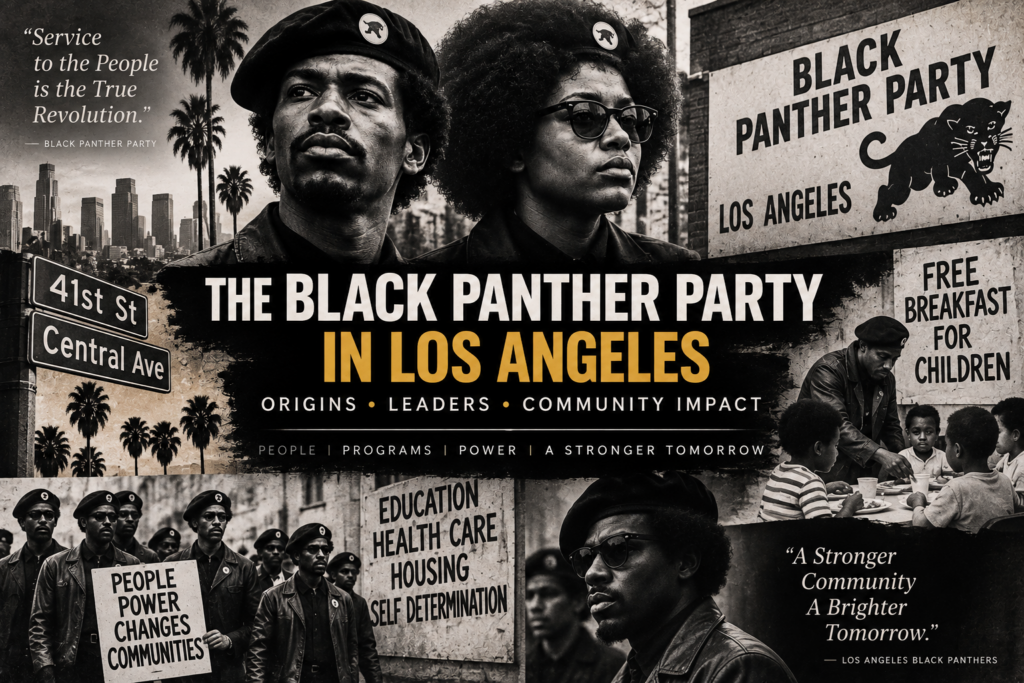
Origins of the Black Panther Party in Los Angeles
The Black Panther Party was founded in Oakland, California, in 1966 by Huey P. Newton and Bobby Seale. The organization soon gained national attention. It then expanded into other American cities, including Los Angeles, where a chapter emerged in 1968.
Los Angeles was already facing intense debates over policing and racial inequality. Housing, employment, and political representation were also major concerns. These conditions helped the Black Panther Party attract young activists. Its message emphasized community self-determination and resistance to police brutality.
Alprentice “Bunchy” Carter became a central figure in the Southern California organization. He helped establish the Panthers’ presence in Los Angeles. This work connected local activism with the broader goals of the national Black Panther Party.
The Los Angeles chapter shared many goals with the national organization. However, local conditions also shaped its development. Relationships with other Black organizations and student activists became important parts of its history.
Key Leaders of the Black Panther Party in Los Angeles
The Black Panther Party in Los Angeles was shaped by organizers who connected neighborhood activism with political education. Student movements also became part of this work. Two important figures were Alprentice “Bunchy” Carter and John Huggins Jr.
Alprentice “Bunchy” Carter
Bunchy Carter became a leading organizer of the Black Panther Party in Southern California. He helped establish the organization’s presence in Los Angeles. His work also connected local activism with the broader goals of the national Black Panther Party.
Carter became involved in student activism at UCLA. His work reflected a growing connection between community organizing and Black student activism. Students were seeking greater representation and educational opportunities.
John Huggins Jr.
John Huggins Jr. was another leader of the Los Angeles chapter. He worked alongside Carter during this formative period. Huggins was also connected to UCLA through the university’s High Potential Program. He participated in political and educational organizing around the campus.
Carter and Huggins linked the Los Angeles Black Panther Party with student and community activism. Their deaths at UCLA on January 17, 1969, became a defining event in the chapter’s history.
Community Programs of the Black Panther Party in Los Angeles
The Black Panther Party in Los Angeles was not focused solely on political protest. Community service was also an important part of its work. These programs addressed immediate needs while also building political awareness.
Free Breakfast for Children
The Free Breakfast for Children Program became one of the party’s best-known initiatives. In Los Angeles, Panthers and their supporters provided meals to children before school.
The program also developed connections with UCLA. Panther members worked with UCLA food services to obtain leftover food for the Los Angeles breakfast program. This cooperation connected student activism with neighborhood organizing. It also provided practical support for local communities.
Health and Community Support
The Panthers also promoted access to health care and other forms of community assistance. Their approach connected food, health, education, and political participation with the needs of Black communities.
These programs added another dimension to the public image of the Black Panther Party. The organization was widely known for confrontations with law enforcement and its position on armed self-defense. However, community programs were also a significant part of its activities.
Organizing Beyond Protest
For the Los Angeles chapter, community programs also provided opportunities to build relationships with residents. Food distribution, political education, and other forms of assistance connected the organization’s larger political objectives with problems people encountered in everyday life.
This combination of activism and community service became an important part of the Black Panther Party’s legacy, both in Los Angeles and nationally.
Conflict and Surveillance of the Black Panther Party in Los Angeles
The growth of the Black Panther Party brought increasing attention from law enforcement agencies. At the national level, the Federal Bureau of Investigation targeted the Black Panther Party through COINTELPRO, a counterintelligence program that used tactics including surveillance, infiltration, and efforts to create divisions within organizations.
COINTELPRO and the Black Panther Party
The FBI expanded COINTELPRO to include the Black Panther Party in 1967. The program became one of the most controversial aspects of the federal government’s response to political organizations during this period.
FBI records and later government reviews revealed that some COINTELPRO operations went beyond conventional investigation. Tactics included infiltrating organizations, attempting to discredit activists, and encouraging internal conflict.
These activities form an important part of the historical context surrounding the pressures faced by Black Panther chapters across the United States, including activists in Southern California.
The 1969 Confrontation at 41st and Central
One of the most significant confrontations involving the Los Angeles Panthers occurred at the chapter’s headquarters near 41st Street and Central Avenue in December 1969.
On December 8, police and Black Panther members became involved in an extended armed confrontation at the location. The event became a major episode in the history of the Los Angeles chapter and illustrated the increasingly tense relationship between the Panthers and law enforcement.
The confrontation at 41st and Central would later become central to accounts of the Los Angeles Black Panther Party and to efforts to document the experiences of people who witnessed or participated in this period.
Legacy of the Black Panther Party in Los Angeles
The legacy of the Black Panther Party in Los Angeles extends beyond the years in which the chapter was most active. Its history remains connected to debates about policing, political activism, community self-determination, education, and the role of grassroots organizations in addressing social inequality.
Remembering Bunchy Carter and John Huggins
The deaths of Bunchy Carter and John Huggins at UCLA became an enduring part of the history of Black activism in Los Angeles. Their lives and political work continue to be commemorated at UCLA, where memorial events have preserved their connection to student activism and the struggle for greater representation in higher education.
Their story also illustrates how the history of the Los Angeles Panthers extended beyond neighborhood organizing. The chapter intersected with student movements, debates over Black Studies, and efforts to expand educational opportunities for Black students.
Preserving the History of the Los Angeles Chapter
Documentary work by filmmakers such as Gregory Everett, along with oral histories, archival collections, and academic research have helped preserve accounts of the Los Angeles chapter and the people involved in it. These sources provide perspectives that extend beyond the national history of the Black Panther Party and highlight the distinct experiences of activists in Southern California.
Preserving these accounts is particularly important because the history of the Los Angeles chapter includes community programs, political organizing, internal and external conflicts, government surveillance, and confrontations with law enforcement.
A Continuing Historical Legacy
The history of the Los Angeles Black Panthers remains relevant to discussions about race, political power, community organizing, and policing in the United States. Their story demonstrates how a national political movement developed differently in response to local conditions and how events in Los Angeles became part of the broader history of the Black Power era.
Examining this history through surviving records, firsthand accounts, scholarship, and documentary work allows the complexity of the Los Angeles chapter to remain visible for future generations.
Conclusion
The Black Panther Party in Los Angeles developed into an important chapter of a national movement while responding to the distinct political and social conditions of Southern California. Through figures such as Bunchy Carter and John Huggins, the chapter connected neighborhood organizing with student activism and broader demands for political and social change.
Its history was shaped by more than confrontation. Community programs, political education, organizing, government surveillance, and conflicts with law enforcement all contributed to the complex story of the Los Angeles Panthers.
Events at UCLA and the confrontation at 41st and Central remain central to understanding this history. Decades later, memorials, archival research, oral histories, and documentary work continue to preserve the experiences of the people involved and provide new generations with ways to examine the legacy of the Black Panther Party in Los Angeles.
This history also reflects the broader legacy of South Central Los Angeles and the communities that shaped the area over generations.